
- In what ways does your media product use, develop and challenge forms and conventions of real media texts?
Deliberately, the costume for Alec – a homeless man who lives in the futuristic city –
consists of ragged jackets, scarves and a woollen hat. Alec represents a stereotypical
homeless man as his costume has connotations of deprivation and destitution. Alec’s
costume enhances the postmodern themes of nihilism and poverty within my trailer.
Importantly, another location seen in the trailer for ‘Blood Feud’ is a crime scene.
Arguably, my film could only be considered part of the neo-noir, science-fiction genre if it
included a theme of crime as this is a prevalent convention within this genre.
Subsequently, this location developed the theme of crime as it became an influential
aspect of my film’s narrative.
CLICK HERE FOR A LINK TO THE QUESTION 1 HOMEPAGE

PLEASE CLICK THE IMAGE TO VIEW MY LOCATIONS RESEARCH
Likewise, Anderson’s office was a significant location for developing Anderson’s representation as an indomitable hero, working tirelessly against the Leader’s government. However, it could also be implied that offices develop pessimistic ideas too as they are unnatural, thus depicting the belief that humans will become over-reliant on technology.
Definitely, in the trailer for ‘Blood Feud’, police tape was a prop that was used to develop characters and locations. Pulling down the police tape demonstrates how Anderson is a stereotypical vigilante and social dissident. Moreover, the action builds tension, thus establishing the crime scene as an interesting location. In terms of postmodern concepts, the location is an homage a scene from ‘Watchmen’ (2009) when Rorschach (Jackie Earle Harley) investigates a crime scene.

PLEASE CLICK THE GIF BELOW FOR A LINK TO MY PROPS RESEARCH
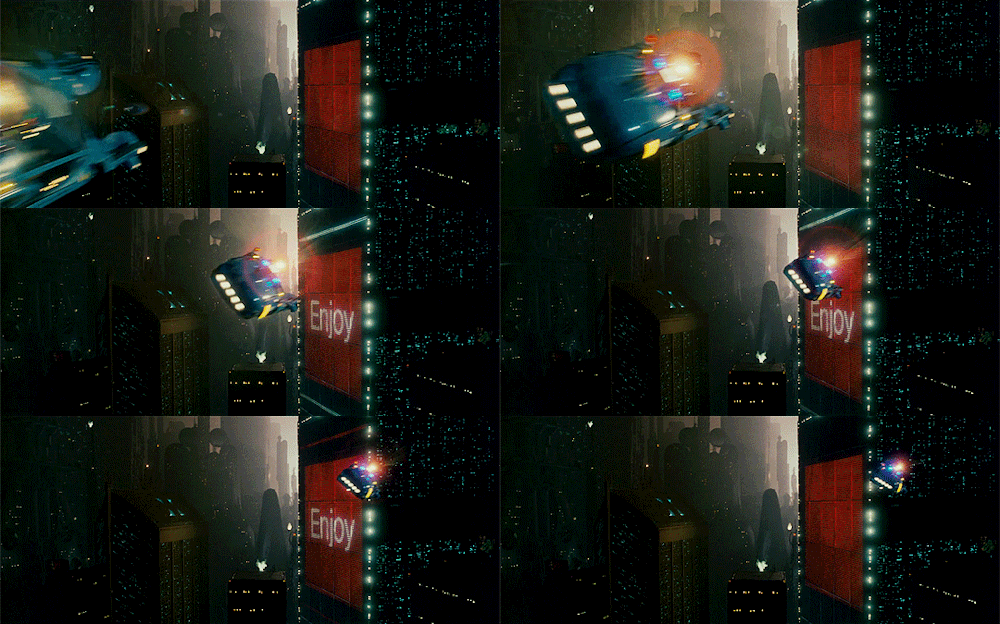
Furthermore, items from Anderson’s office were useful props for progressing Anderson’s characterisation. I used large books, papers and folders to emphasise how Anderson is productive, industrious and hard-working. The decision to use this location was inspired by the offices seen in ‘Blade Runner’ (1982) and ‘The Matrix’ (1999).
Similarly, Alec’s items were props that contributed to the representation of Alec as a homeless person. Evidently, a tin can, cardboard sign, blankets and spare change that developed this representation.
Unquestionably, canted angles are often used to convey an altered state. For example, they are used in ‘Die Hard’ (1988) and ‘The Dark Knight’ (2008) to demonstrate increasing tension and violence. In terms of genre, ‘The Third Man’ (1949) was one of the most important films for popularising this angle in film noir. Subsequently, the canted angle in my trailer develops the idea that Anderson is psychologically troubled by his past.
PLEASE CLICK THE IMAGE ABOVE FOR A LINK TO MY TRANSITIONS RESEARCH
Prominently, I developed my use of camera positioning. For instance, one form of camera positioning is that two-shots are used to imply that the characters in the shot have a close relationship. Therefore, in the flashback scenes, I used a two-shot of Anderson and his mother to depict their loving relationship. In contrast, the pessimistic heartlessness of the futuristic city is displayed as the characters in this location appear in shots on their own, rather than in two-shots.

PLEASE CLICK THE IMAGE TO VIEW MY MUSIC DEVELOPMENT & DESIGN
In the trailer for ‘Blood Feud’, the use of an additive dissolve transition effect portrays Anderson’s altered mental state. Alternatively, the cross dissolve transition developed my ideas about the dystopian setting – this transition is frequently used to prevent the passing of time so using it for Alec’s scenes conveys homelessness as an ongoing social problem. It could indeed be argued that the dip to white transition often indicates a shift in chronological time, thus I used this transition to intensify Anderson’s flashbacks.
In terms of music, I developed my own composition through a combination of genres. For instance, the synth keyboards are electronic instruments that are often used in music science-fiction, whilst the guitars and drums, at the end of my music, created a blues rock tone – which is more commonly associated with the action-adventure genre. I developed the forms and conventions of trailer music as I utilised the postmodern idea of not being restricted by a single genre.