
- In what ways does your media product use, develop and challenge forms and conventions of real media texts?
CLICK HERE FOR A LINK TO THE QUESTION 1 HOMEPAGE
PLEASE CLICK THE IMAGES BELOW FOR LINKS TO MY CONVENTIONS RESEARCH
Firstly, I used the forms and conventions of real media texts to create a costume for
Anderson – the main protagonist in ‘Blood Feud’. Anderson’s suit is useful for developing
his characterisation as it portrays him as confident, powerful and professional. Arguably,
Anderson’s costume is stereotypical for a detective character in the neo-noir genre.
Deliberately, the costume is an example of pastiche – a common form within postmodern
film – as it intimates the costumes worn by Dominick Cobb
(Leonardo Di Caprio) in ‘Inception’ (2010) and John Wick (Keanu
Reeves) in ‘John Wick’ (2014).
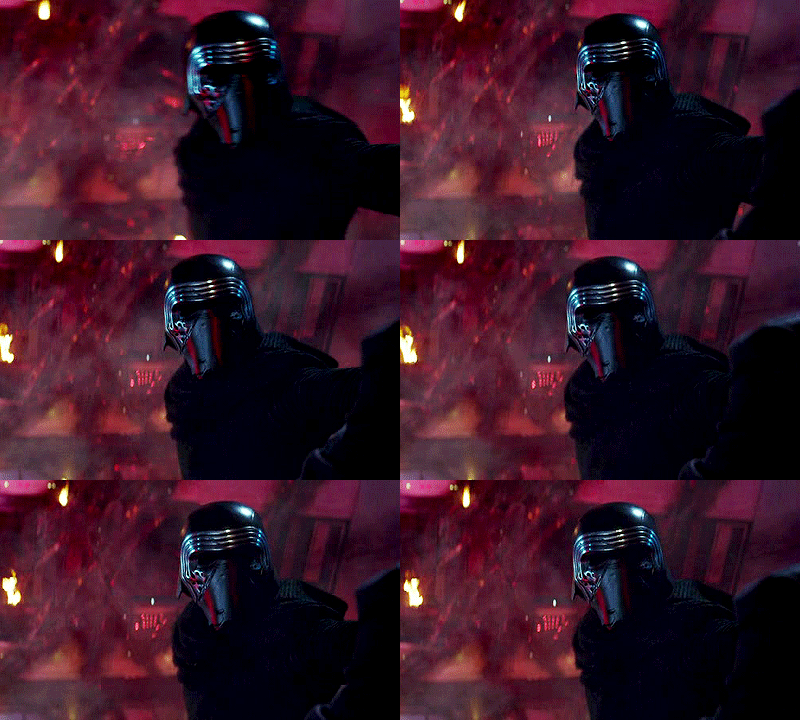
Notably, in ‘Blood Feud’, the Leader – the main antagonist –
wears a grey robe and black breathing apparatus. The Leader’s
costume, specifically his breathing apparatus, was inspired by
Kylo Ren (Adam Driver) from ‘Star Wars: The
Force Awakens’ (2015). Consequently, his
costume conveys a futuristic theme, especially
in terms of advanced technology, which is a
common convention within the neo-noir,
science-fiction genre.
Certainly, the grey colour of the government worker’s shirt and cap evoke
connotations of uniformity. Inspired by the costumes seen in science-fiction
film ‘1984’ (1984), the costume I have created for the government worker
uses the forms of real media texts as costumes effectively complement
setting – the suggestion of uniformity depicts a dystopian society that
enforces conformity and the repression of individuality.
Undeniably, futuristic cities are a common location in neo-noir, science-fiction films. Frequently, these cities are portrayed as bleak and over-reliant on technology in order to construct a cynical, anti-rational view of society. The use of a futuristic city as a location was inspired by the other futuristic cities seen in postmodern films, such as ‘Star Wars’ and ‘Tron: Legacy’ (2010).
I wanted to further the pessimistic view of society constructed by the futuristic city, so I also used a dirty street as a location in ‘Blood Feud’. Appearing at the start of the trailer, the use of this location was similar to the trailer for ‘District 9’ (2009) as it
encouraged my audience to feel pity for the characters, such as Alec, living in this dystopian wasteland.
Genre
conventions
Trailer form & conventions

PLEASE CLICK THE IMAGE TO VIEW MY COSTUMES RESEARCH

Additionally, the control of the population explored in ‘1984’ (1984) encouraged me to use a propaganda poster in ‘Blood Feud’. The Leader’s poster is an example of parody as it is akin to the ‘Hope’ poster used by Barack Obama during his 2008 Presidential campaign.
Furthermore, Anderson’s car was another prop that I used in my trailer. Characteristically, a car could be considered a convention of the neo-noir, science-fiction genre as they were frequently used in ‘Blade Runner’ (1982).
Markedly, during the post-production process, using a colour correction effect tool allowed me to add a green tint to my shots, thus making my film look similar to ‘The Matrix’ (1999). Subsequently, I used lighting conventions as the despairing connotations of low-key lighting helped me to suggest that ‘Blood Feud’ is set in a dystopia.
Evidently, ‘Inception’ (2010), ‘Mad Max: Fury Road’ (2015) and ‘Rogue One: A Star Wars Story’ (2016) all use an establishing long-shot of a location in their trailers. Similarly, in ‘Blood Feud’, since this camera shot is clearly useful for displaying locations, I used an establishing long-shot of a futuristic city to follow this form.
In addition, I used camera angles to establish characterisation. For example, my trailer includes low-angle shots of the Leader to portray him as intimidating and powerful. Consequently, this angle meant that I constructed a representation that conformed to the postmodern trope of future societies being ruled by terrifying, authoritarian governments.
During my research into film trailers, I noted that numerous trailers use lens flares, fade to black transitions and slow paced cuts at the start and fast paced cuts at the end in order to keep the audience in suspense. Consequently, I used these editing techniques to comply with the conventions of film trailers.
PLEASE CLICK THE IMAGES BELOW FOR LINKS TO MY TITLES DESIGN & AFTER EFFECTS RESEARCH
Titles research & design
After Effects research
Moreover, I analysed film titles in order to understand how I could create my own titles
that would use the forms and conventions of real text examples. Particularly, I noted how
titles, in film trailers, are often bold, colourful, placed in the centre of the screen (horizontally and vertically) and use a large font size. Subsequently, I applied these conventions to my own production.